

Worldbuilding 101
The best way to make your world feel cohesive

Some like to make it up as they write, some would rather not think about it at all, and others spend so much time doing it they forget to actually write their novel (…guilty): Worldbuilding!
Whether you are working on your epic fantasy, historical romance, or space opera, worldbuilding lays the groundwork for a story rooted in its environment. It can range from broad political constructs and religions to fantastical creatures, languages, and the local cuisine. It is everything that makes your story feel real and makes the reader get completely lost in it. However, as fascinating as worldbuilding can be, it can also feel like a rather daunting task that you would want to ignore.
But fear not, for I have some helpful worldbuilding tips for you!
The foundation
How big is the world? How many countries/kingdoms/etc. does it have? What is the climate like? Are there seasons, like in our world? Is there a sun like ours? One moon, or two moons? How would that affect the world and climate? How advanced are the people, and what technological knowledge do they have?
Answering these basic questions first will help you make sense of the more detailed things later. It will help you think about how culture is determined by the environment your characters live in, and how climate changes may affect said culture.
Adding detail
For my first epic fantasy novel, I envisioned a kingdom that has a very steady climate, with heavy rainfall a few times a year. Based on that, I thought about what houses would look like in that environment, what the people would celebrate, and whom they would pray to. I created a bunch of gods that are rooted in folklore.
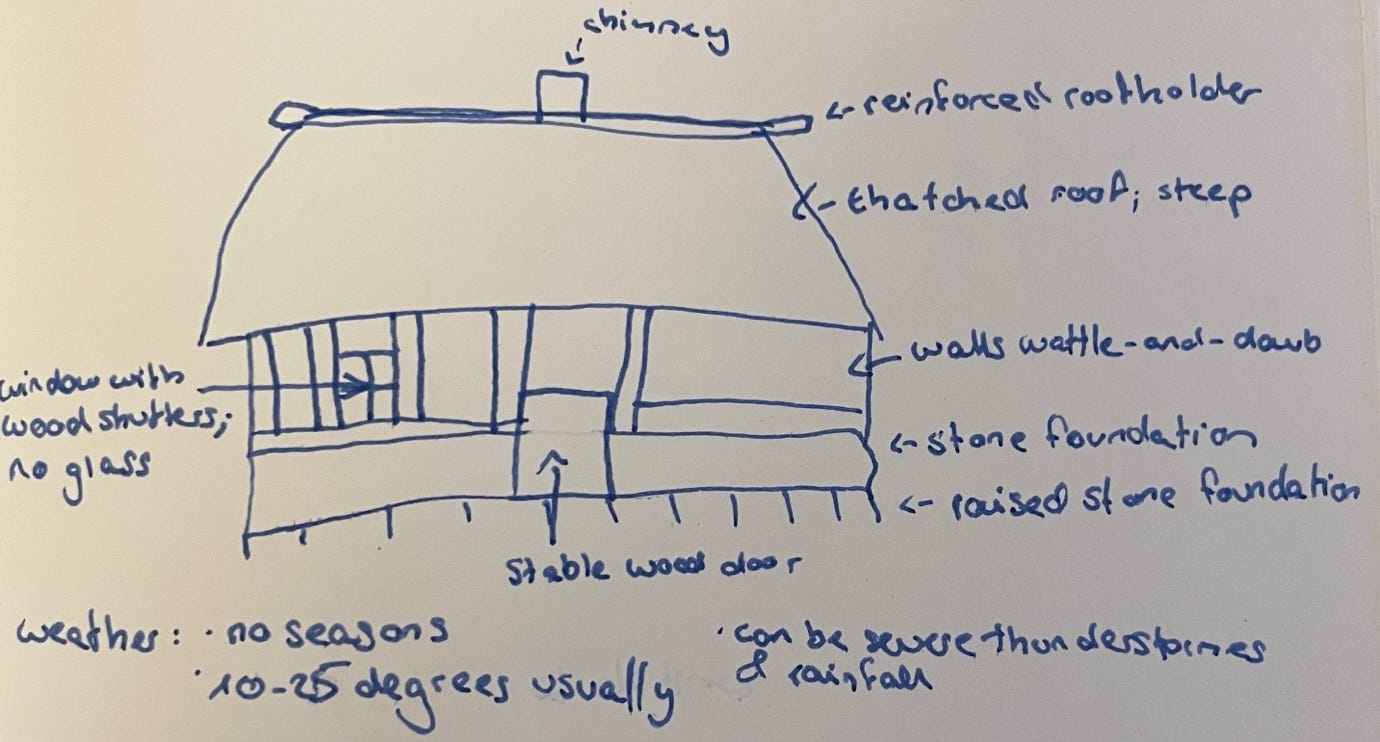
Once you have the basics of your world, you can think about religion, traditions, dialects, food, trade, etc. To make your world feel cohesive, it can be helpful to ‘zoom in’ on one particular aspect of the world and try to track it back to its origins. Is there a certain type of food in your world? Where do the ingredients come from? Who is harvesting? How does trading work in your world? How is food being stored? And so on, and so on.
During my master’s, we looked at a helpful graphic called ‘The Cultural Iceberg’, which I would like to share with you today. Now, do you have to develop and integrate every single one of these areas? Maybe not. But if you know the answers to most of them, it can make your world feel more realistic and enticing. The reader might never learn about everything you planned out, but they will be able to tell if a world is well thought through.
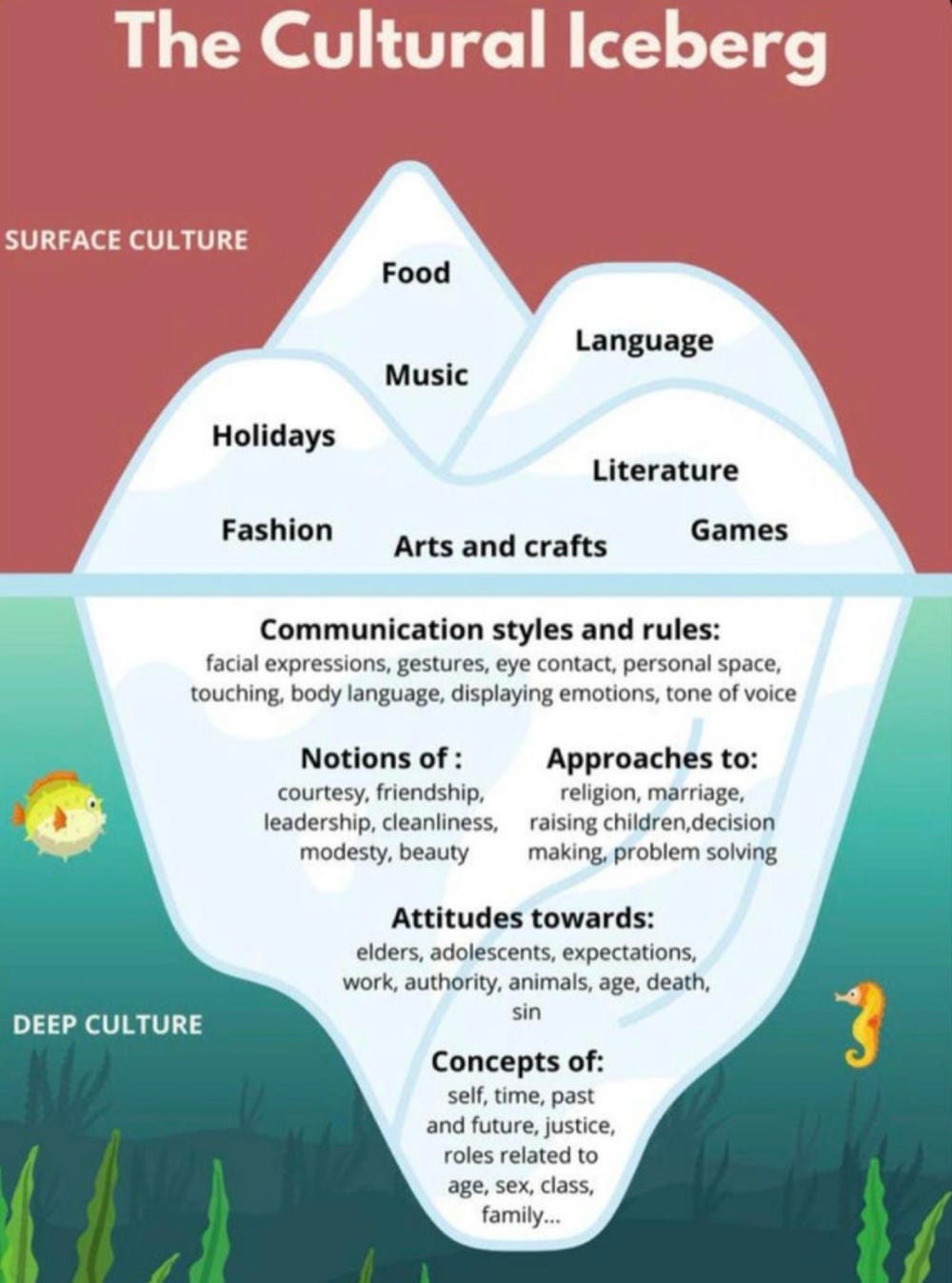
There are a lot of online resources for worldbuilding, with prewritten questions you can answer to create a detailed world. Check out a detailed list of questions here.
Now, an example from my own work! For my epic fantasy novel, I decided I wanted there to be two moons in the sky, Lua and Luan, who got separated by the god of thunder because of their endless sibling quarrels. When Luan leaves the sky, the heavy rainfall begins, which humans then explained as Lua crying for her brother. I connected a weather event to culture and folklore, making the world feel more in-depth in the process.
The history
Once you feel you know everything about the world your characters live in at the time of your novel, it is helpful to think about the history as well. What led the world to be as it is today? Have there been wars, colonisation, or catastrophic climate events? What would society have looked like before these events, and how could that add to the thematic architecture of your story? If cultures carry trauma from century-long wars, that might affect them today and determine how they go about their life. If royals used to hold all the power, and then there was a shift to religion, how would the royals react to that new order?
I know, a lot of questions.
Finding the balance between curiosity and strict rules
Now, depending on what your goal with your story is, it might be beneficial not to have an answer for all the questions. It can leave your reader with a certain sense of wonder, which can be its very own magic in building suspense and intriguing the reader. Stories in Middle Grade or Young Adult won’t necessarily need the same amount of detail as their adult counterparts.
However, be careful that wonder doesn’t turn into disbelief. Research reader expectations for the genre you write in and assess how important worldbuilding is for the themes of your novel. Finding that balance between withholding information and explaining things is key.
Constricting your world, magic system, and culture by rules can be incredibly helpful when it comes to setting boundaries for your novel. Would you want everything to be possible, or will certain rules benefit your story and its believability?
Showing your world through characters
Now, you’ve built your world, written history, and have an answer to every question someone could throw your way. How do you integrate that into your novel now?
One way to show your worldbuilding without it turning into paragraphs of exposition is through your characters. Your protagonists should be a product of the society you built, of the world they live in, and the norms they grew up around. Use your narrative to show the characters moving through the world you built and reveal information about the world through their interactions. Do they pray before they eat? Do they pray to all gods equally? Do they look up at the sky and worry about a terrible storm to come that might wipe out their entire village?
Be careful not to force-feed that information. If something is relevant, reveal it to the reader through a piece of dialogue. You don’t have to explain everything, but enough for the reader to fill in the gaps and let the rest be implied.
Trust your readers to figure things out without you having to spell it out for them.

Reveal only the essentials
Does your reader need to know a small event in your world’s history that has no connection with the current story whatsoever? Probably not. It can be tempting to want to share every detail you have worked so hard on in your story, but the truth is, you only need to include the things necessary to follow the story. If a past event has a direct connection with what is happening now, then share it!
One essential question in connection with worldbuilding that should be answered, and has been drilled into my head by my teachers during my master’s, is: Why is the story happening now?
Is it because of the main character’s personality? A cosmic event? The right group of people meeting at the right time?
This question is what will drive your story forward and make it feel important, so don’t ignore this part!
Some helpful resources for worldbuilding
- Inkarnate for maps
- Reddit for hearing people’s opinions about ‘What ifs’, especially if you don’t have a lot of knowledge in a certain field
- The library for researching history and cultures, and deciding what could be applied to your world
- Pinterest for moodboards, and capturing the feeling of your world
Now, I have a confession to make. I absolutely LOVED worldbuilding for my epic fantasy novel, but when it came to my dystopian urban fantasy, which takes place in an alternate version of our world today, I had 90% less fun. So, I rushed the process. As a result, the world I built didn’t feel finished, and unfortunately, didn’t make much sense historically, which was kindly pointed out to me by one of my beta readers (lots of love to you).
Was I initially happy about that feedback? Definitely not, but it also gave me the chance to think about the world of my story once again, to see where I could make things more impactful and shape the characters’ actions and personalities. I was also grateful that someone pointed out the flaws of the world, which somebody with less historical knowledge might not have noticed.
I am going to start the next (and hopefully last) round of edits tomorrow, and I am scared and excited at the same time!
What are your thoughts on worldbuilding? Do you love it, or would you rather not think about it at all? Let me know!
I have done some world building for my RPG campaigns (Champions, D&D) over the decades, so I am in tune to all of this. Really liked the Culture Iceberg - will use that in the future.
The two moons causing rainfall, and Lua crying for her brother. That's the whole iceberg principle in one image. Climate becomes myth becomes emotion. Neat.